





|
Kingdom: Animalia Phylum: Chordata Class: Aves (Birds) Order: Anseriformes Family: Anatidae |
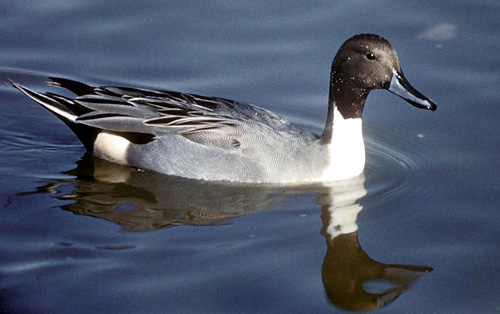
Northern Pintail (Anas acuta) is found in the wetlands, and is a common and widespread winter visitor in India. Derived from the Latin word "acus" meaning "needle", the species name, acuta, refers to their characteristic sharply-pointed "pintail". Springing into flight from the water's surface, these ducks do not require a running take-off and are distinguished in the air by their line formation. Local names: Seenkhpar, Sand Size: upto-70 cm Identification: These slim, elegant ducks have long, narrow, pointed wings, long necks and very long, slender and tapering tails. Sexes different. Adult males have a rich, chocolate brown head stripe, running from the top of the crown to the bottom of the nape. The remainder of the face and the top of the throat are a solid, lighter brown save for the distinctive line of bright white that creeps up the back of the neck towards the head. The brown head and throat sharply contrast with the stark white of the lower throat, breast, belly and flanks. In males, the black, central tail-feathers extend far beyond the rest of the long, wedge-shaped tail. The female is a nondescript, mottled brown overall, although the neck and head are slightly paler than the rest of the body. Though the female also has a relatively long, wedge-shaped tail, it lacks the extended central feathers of the male. Both sexes display a dark, brownish speculum (swatch of color on the leading edges of the wings) and a uniformly bluish-gray bill. Habitat: Found at lakes, reservoirs and marshes; one of the commonest migratory species in North India. Highly gregarious, keeps in flocks up to hundreds, arrives in North India by September-October and departs by end of March. Common and widely distributed winter visitor to whole of India. Calls: The female Northern Pintail produces a quiet, hoarse quacking. Courting males give a high, wiry and drawn-out "Zoeeeaaaa" call. They also make short, melodious, mellow whistled "pruded" or "toop" notes. Nests: Although Northern Pintails are dabbling ducks, they seldom nest near water. The female builds the nest in wallowed out ground depressions (scrapes) on dryer portions of their habitat. Concealed by high grass and stubble, the nest is filled with dry grasses and leaves. Lined with fine materials, the soft nest is safe haven for the 6-12, 54 mm, olive green eggs of the clutch. The female alone incubates the clutch for 22-25 days as the male deserts her early in incubation. As incubation progresses, additional down is added to the nest to insulate the clutch. Young birds fledge in 36-57 days post-hatching and are reared by the female. If the nest is threatened, the female feigns injury to distract the threat while the offspring scatter. When the young are well hidden, the female flies away.
Food: Northern Pintails forage in both freshwater and on land. Ninety
percent of their diet is composed of vegetation, including seeds, aquatic
plants, sedges, grains and wild rice. In freshwater, they primarily feed upon
the leafy parts of aquatic plants, aquatic insects, tadpoles, snails and other
aquatic invertebrates by picking food from the surface of freshwater shallows
(ponds and marshes). By "dabbling," floating on the water's surface and abruptly
pivoting headfirst and downward into the water while raising their hindquarters
above water, these ducks are able to reach submerged aquatic plants and animals
on the muddy bottom. On land, these ducks graze like geese on grasses, grains
and seeds of open fields. |