






|
Kingdom: Animalia Phylum: Chordata Class: Aves (Birds) Order: Galliformes Family: Phasianidae |
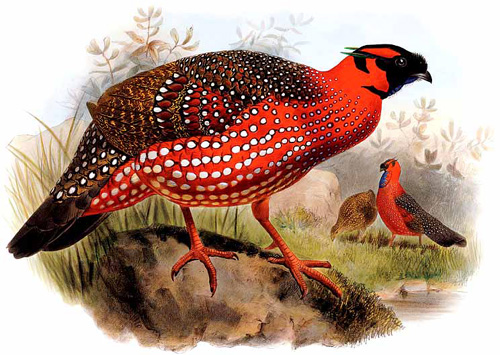 Satyr Tragopan (Tragopan satyra) Linnaeus Satyr Tragopan (Tragopan satyra), also called Crimson Horned Pheasant, is a local resident in Himalayas. Size: Male 68-72 cm; female 58 cm. Weight: Male 1.60-2.10 kg; Female 1.0-1.20 kg. Identification: Male: Head almost completely feathered and black, a crimson streak on each side of the recumbent crest. The sides of the neck, upper back, shoulders, and upper breast, deep crimson. The rest of under parts crimson, speckled with black-edged white spots (ocelli), becoming larger and greyish on the abdomen and flanks. Under tail coverts red, with brown-lined white ocelli, and two larger olive ones on the sides; longer tail-coverts brown with subterminal mottled dark brown and buff. Tip of tail black and the tail is proportionally longer than other Tragopans. Iris brown; bill black; bare skin of throat deep blue; lappet blue in the middle, pale green on the margins, with four or five triangular scarlet patches on each side; fleshy horns blue; the lappet extends to a length of 100 mm and the horns to 75 mm during display. Legs brownish pink. Immature Male: Like the female, but larger and higher on the legs, with a black-head, much red on the neck and upper back, the breast more or less splashed with red, with few white ocelli. Female: Upper parts varying from rufous to dull brown, with pale buff central markings and blackish vermiculations and patches; tail rufous brown with irregular black and buff bars; chin and throat pale brown or buff lined with black. Under parts like the back but much lighter, particularly the abdomen where the pale center of the feathers expands into a large whitish spot. Iris brown; orbital skin bluish; bill horn brown. Legs light grey. Distribution: The Satyr Tragopan is a local resident in central and eastern Himalayas, the range extending from Garhwal and moving east through Nepal, Sikkim, Bhutan and Assam. Prefers forests with dense undergrowth on steep hillsides at altitudes varying from 2000 m to 4200 m.
Food: Seeds, fresh leaves, shoots of bamboo, berries and insects.
Call: A loud pitched 'wak', repeated several times. Also a loud
'kya kya kya'. |
| |
| Apodiformes | Bucerotiformes | Ciconiiformes | Columbiformes | Coraciiformes | Cuculiformes | ||
| Gruiformes | Passeriformes | Piciformes | Psittaciformes | Strigiformes | Trogoniformes | Turniciformes | Upupiformes |
All rights reserved. Copyright © 2005-2013 Birds and birding in India. Disclaimer website: Free Java Guide & Tutorials |