





| Kingdom: Animalia Phylum: Chordata Class: Aves (Birds) Order: Passeriformes Family: Corvidae |
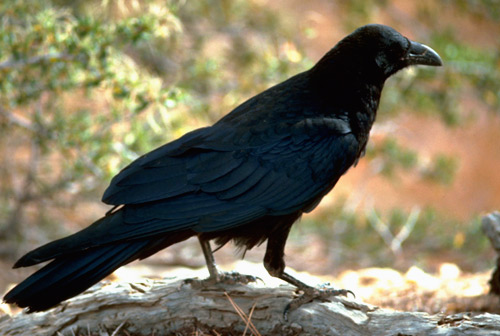
Common Raven (Corvus corax) is a local resident in higher altitudes of Himalayas and north-west India. Size: 60-70 cm. Ravens are glossy, solid-black birds with an incredible variety of low, harsh and raucous vocalizations. The genus name, Corvus, is Latin for "crow," while the species name corax is a derivation of their sounds. As gregarious flocking birds, they fly in long lines to and from their communal roosts. Identification: Ravens are the largest of the passerines (perching birds). Characteristic traits include their long, wedge-shaped tails, long, powerful bills and thick, shaggy throat feathers. Their long, rounded wings extend nearly to the tips of their tails. While the sleek plumage of the adult is completely black, it has a bluish, iridescent sheen in the sunlight. Juvenile birds display gray-based neck feathers. On the fly, Common Ravens soar, flapping only occasionally (distinguishing them from crows that never soar). Calls: The noisy Common Raven has a remarkable variety of vocalizations. Their sounds range from deep, baritone croaks to high bell-like, twangs. Typical calls include a long, hoarse "kraaah," a lower, hollow "brrronk" and a deep, resonant "prruk," although their repertoire is much more extensive. Nests: Nests are built on cliffs or conifers and occasionally in deciduous trees or human-constructs. Over several weeks, both parents assemble the bulky, bowl-shaped nests of branches and twigs and line it with bark and hair. Nests may be repaired and reused perennially. Clutch size varies from 3-7, 50 mm, greenish eggs, marked in browns and olives. The female alone incubates the clutch for 18-21 days but the male feeds her during this time. Young birds fledge in another 38-44 days. Both parents assist in rearing the young. Food: Common Ravens are omnivorous foraging generalists, particularly fond of carrion and garbage. Their powerful bill enables them to feed on carcasses, small vertebrates, bird eggs, nestlings, insects, invertebrates (mollusks), seeds and fruits. These intelligent birds are known to temporarily cache buried food, hunt cooperatively in groups and post a sentinel when feeding. As ground gleaners, they forage by picking prey and food from the ground and vegetation as they walk (rather than hop). Read about Raven's eggs and nests in "The Nests and Eggs of Indian Birds by Allan O. Hume, 1889" |
| |