






| Kingdom: Animalia Phylum: Chordata Class: Aves (Birds) Order: Passeriformes Family: Sylviidae | |
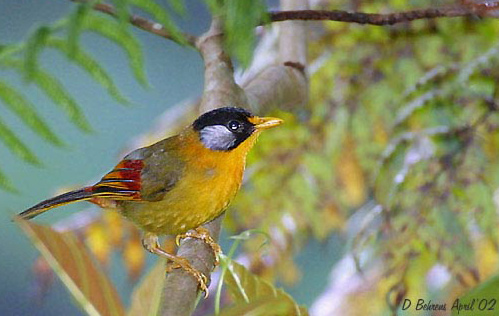 Silver-eared Mesia (Leiothrix argentauris) - photo © David Behrens
Silver-eared Mesia (Leiothrix argentauris) is a local resident in Himalayas and hills of north-east India. Size: 15 cm Weight: 15 gm Identification: Both male and female of Silver-eared Mesia are olive on the dorsal aspect and yellow on the ventral aspect. The crown area is black, ear patches are silver, and there is minimal crimson color on the tail. The bill of both the male and female birds is yellow and made of culmen, an upper and lower mandible is present. The patches on the female's forehead, throat, and breast area are duller than the male's. The yellow colored area on the abdomen of the female is smaller than the male's. Females have light yellow under-tail coverts, lighter red-dish wing-patches, and a duller yellow fringes to the flying feathers than males'. Adult and juvenile Silver-eared Mesias resemble one another. The juvenile's slightly faded body color, and lessened black sheen on the head, differs from the adult bird. The eyes nearly touch in the median plane of the skull and can weigh as much as, or more than the brain. The outside pinna of the ear is missing and is replaced with ear coverts. There are three front toes (inner front toe, central front toe, and outer front toe) and one hind toe (hallux) on each foot. Distribution: Silver-eared Mesias are distributed from the Eastern Himalayas in India to Western China, ranging South, down through Indo-China to Malaysia and Sumatra. They also reside in North, Northeast Indian subcontinent, Southwest China and Southeast Tibet. They live in bushes on the edge of broadleaved forest, secondary growth, jungle and scrub at elevations of 500-2,000 m. Food: Silver-eared Mesias prey upon insects and some plant material. Vegetables and certain fruit are eaten when available, and they search for berries under bushes. Worms are not in their diet. The cock will feed the juveniles captured insects. Breeding: Three to four large eggs are laid at a time. They usually hatch 13 days after the hen starts sitting on them. The average size of an egg is 21.75 x 16mm (7/8 x 5/8") weighing 3.25g. Chicks leave the nest at 12 days of age and can feed on their own once they are three weeks old. Call: Silver-eared Mesias calls are very loud and the whistle is instantaneous, like that of an alarm, when they are trapped or chased. While singing they repeat "che tchu-tchu che-rit" or "che chu chiwi chwa". The sound is pleasant and the spacing is obvious. A flat "pe-pe-pe-pe-pe" resembles a flute. Habits: They prefer small flocks and travel in groups of 6 to 30 birds. They sleep closely together and groom each other frequently. They mate for life. The cock's breeding song is a very loud call with five notes and the "churr" is soft. When they begin to nest the black color of the end of their bill turns clear ivory. While the eggs are incubating under the hen at night, the cock sits near by on another twig or on the edge of the nest. The cock will at times, sit between the hen and rim of nest. Chicks can find food on their own at three weeks, but are fed by parents up to one month of age. At 12 days of age, chicks are able to fly about three feet in distance. Male chicks try to sing once six to seven weeks old. |
 birding.in
| Birds | Bird Diagram | Ornithology | Indian Sites | Bird Watching | Migration | North India | Birds of India | Haryana |
All rights reserved. Copyright © 2005-2013 Birds and birding in India. Disclaimer
website: Free Java Guide & Tutorials