






| Page 13 | |
|
Natural History of the Mammalia of India and Ceylon - by Robert A. Sterndale F.R.G.S., F.Z.S. (1884) | |
| prev page next page | contents |
ORDER CARNARIA.
CHEIROPTERA.
|
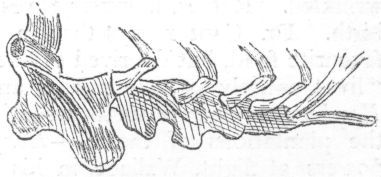
| Sternum of Pteropus |
It may seem strange to many that such an insignificant, weird little creature as a bat should rank so high in the animal kingdom as to be but a few removes from man. It has, however, some striking anatomical affinities with the last Order, Quadrumana, sufficient to justify its being placed in the next link of the great chain of creation.
"Bats have the arms, fore-arms and fingers excessively elongated, so as to form with the membrane that occupies their intervals, real wings, the surface of which is equally or more extended than in those of birds. Hence they fly high and with great rapidity."—Cuvier. They suckle their young at the breast, but some of them have pubic warts resembling mammæ. The muscles of the chest are developed in proportion, and the sternum has a medial ridge something like that of a bird. They are all nocturnal, with small eyes (except in the case of the frugivorous bats), large ears, and in some cases membranous appendages to the nostrils, which may possibly be for the purpose of guiding themselves in the dark, for it is proved by experiment that bats are not dependent on eyesight for guidance, and one naturalist has remarked that, in a certain species of bat which has no facial membrane, this delicacy of perception was absent. I have noticed this in one species, Cynopterus marginatus, one of which flew into my room not long ago, and which repeatedly dashed itself against a glass door in its efforts to escape. I had all the other doors closed.
Bats are mostly insectivorous; a few are fruit-eaters, such as our common flying-fox. They produce from one to two at a birth, which are carried about by the mother and suckled at the breast, this peculiarity being one of the anatomical details alluded to as claiming for the bats so high a place.
Bats are divided into four sub-families—Pteropodidæ, Vampyridæ, Noctilionidæ, and Vespertilionidæ.
MEGACHIROPTERA.
SUB-FAMILY PTEROPODIDÆ.
GENUS PTEROPUS.
These are frugivorous bats of large size, differing, as remarked by Jerdon, so much in their dentition from the insectivorous species that they seem to lead through the flying Lemurs (Colugos) directly to the Quadrumana. The dentition is more adapted to their diet; they have cutting incisors to each jaw, and grinders with flat crowns, and their intestines are longer than those of the insectivorous bats. They produce but one at birth, and the young ones leave their parents as soon as they can provide for themselves. The tongue is covered with rough papillæ. They have no tail. These bats and some of the following genus, which are also frugivorous, are distinguished from the rest of the bats by a claw on the first or index finger, which is short.
Dental formula: Inc., 4/4; can., 1—1/1—1; premolars, 2—2/3—3; molars, 3—3/3—3.